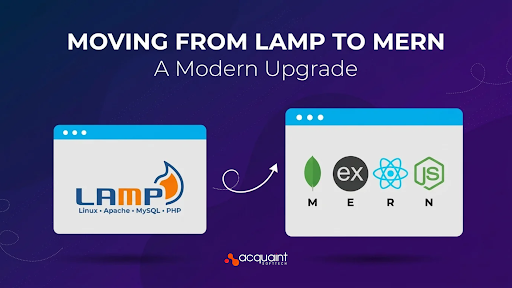
Nobody rebuilds a house because they want a new kitchen. They rebuild when the foundations can no longer support the life they want to live in it, and even then they plan carefully, because a rebuild is expensive and disruptive. A PHP to Node.js migration deserves the same thinking. Moving a working LAMP application (Linux, Apache, MySQL and PHP) to MERN (MongoDB, Express.js, React and Node.js) can unlock real benefits, but only for the right reasons. A clear LAMP vs MERN comparison is a useful starting point before committing budget to a rewrite.
In short, migrate from PHP to Node.js when your product’s direction, such as real-time features, high-concurrency APIs, a rich React interface or a JavaScript-focused team, is genuinely held back by the current stack. Do not migrate just because a technology is newer. Many PHP applications are better served by upgrading and modernising in place, or by adding Node.js services alongside the existing system rather than replacing it all at once.
The guidance reflects how Acquaint Softtech plans and delivers stack migrations as an ISO 27001-certified technology partner, drawing on 1,300+ projects and 70+ in-house engineers serving clients in the USA, UK, Europe, and Australia.
Should you migrate from PHP to Node.js?
Only if there is a business case. Modern PHP is fast, mature and well supported, so performance alone is rarely a strong enough reason. A migration makes sense when the current stack blocks features your customers want, makes hiring difficult, or forces your team to maintain two languages for one product.
Five signs the migration is worth it
1. Your product needs real-time features
Chat, live dashboards, notifications and collaboration rely on long-lived connections, which Node.js’s event-driven model handles naturally.
2. You are building API-first or high-concurrency services
If the application is becoming a set of APIs serving web, mobile and partner integrations with many simultaneous requests, Node.js is a strong fit.
3. The front end is already moving to React
When the interface is being rebuilt in React anyway, moving the back end to Node.js lets one team work in one language across the whole product.
4. Your data model keeps changing
Products whose data shape evolves quickly can benefit from MongoDB’s flexible documents, compared with frequent schema migrations in MySQL.
5. The legacy code is a bigger problem than the language
If the PHP codebase is on an unsupported version, poorly structured and untested, a carefully planned rebuild can cost less over time than continuous patching. In this case, compare a rebuild in modern PHP as well as in Node.js.
When staying on LAMP makes more sense
| Situation | Better choice | Why |
| Content-driven site or CMS-based product | Stay on LAMP | Mature tools for editors and content |
| Complex relational data and transactions | Stay on LAMP or keep MySQL | Relational databases handle this well |
| Strong PHP team, no Node.js skills | Stay on LAMP | Retraining adds cost and risk |
| Stable product with few new features planned | Stay on LAMP | Little return on a rewrite |
| Tight budget and simple hosting needs | Stay on LAMP | Lower running and migration costs |
Alternatives to a full rewrite
A full rewrite is not the only path. Three lower-risk options often deliver most of the benefit:
- Modernise the PHP application. Upgrade to a supported PHP version, adopt a modern framework, add tests and clean up the architecture.
- Add a React front end to the existing back end. Expose PHP functionality as APIs and rebuild the interface in React, keeping proven business logic in place.
- Grow new features in Node.js alongside PHP. Build real-time or high-traffic services in Node.js and route traffic to them gradually, retiring old PHP modules over time.
The last approach, sometimes called the strangler fig pattern, lets teams migrate piece by piece while the business keeps running.
What a LAMP to MERN migration involves
| Layer | From | To |
| Server language | PHP | Node.js with Express.js |
| Database | MySQL tables | MongoDB documents (or MySQL kept with Node.js) |
| Front end | Server-rendered PHP pages | React application |
| Hosting and deployment | Apache on Linux | Node.js processes, containers or managed platforms |
The data model is usually the hardest part. Translating many related MySQL tables into MongoDB documents means deciding what to embed and what to reference, and getting that wrong creates performance problems later. Careful MongoDB schema design before data is moved avoids most of them. It is also worth noting that Node.js works well with MySQL, so some teams move to Node.js and React first and change the database later, or not at all.
Read Also: How Orthodontists Stay Updated On The Latest Techniques
How long does a LAMP to MERN migration take?
A typical LAMP to MERN migration for a medium-sized application takes around two to six months, depending mostly on data complexity. Small applications with simple data can move faster, while large systems with many integrations and years of business rules can take considerably longer. The main factors are:
- Data complexity: the number of tables, relationships and data-quality issues.
- Business logic: how much hidden logic sits in the PHP code and database procedures.
- Integrations: payment providers, third-party APIs and internal systems.
- Approach: a phased migration takes longer in total but carries far less risk than a single switch-over.
A low-risk migration plan
- Assess first. Map the codebase, data, integrations and the business reasons for moving
- Decide the target. Choose full MERN, Node.js with MySQL, or a partial migration.
- Migrate in slices. Move one module or user journey at a time behind a routing layer.
- Move data carefully. Script, test and repeat data migrations before the final run.
- Run in parallel. Compare results between old and new systems before switching traffic.
- Retire old code. Remove PHP modules only after the new ones have proven stable.
An independent MERN stack consulting assessment at the start helps confirm whether the migration is worth it, which approach suits the system and where the biggest risks lie, before any code is rewritten.
Making the call
A sound house with a dated kitchen needs a renovation, not a demolition. The same is true for most PHP applications. Migrate to MERN when real-time features, API-first growth, a React front end or team skills make the current stack a genuine constraint, and plan the move in phases with careful data modelling. If those drivers are missing, modernising the PHP application, or adding Node.js services alongside it, usually delivers more value for less risk.
FAQs
Should I migrate from PHP to Node.js?
Only when the current stack blocks important features, hiring or team efficiency. Modernising PHP is often the better option otherwise.
How long does a LAMP to MERN migration take?
Around two to six months for a medium-sized application, depending mainly on data complexity, business logic and integrations.
Do I have to move from MySQL to MongoDB?
No. Node.js works well with MySQL. Some teams change the back end and front end first and keep their relational database.
What is the safest way to migrate from PHP to Node.js?
A phased migration that moves one module at a time, runs old and new systems in parallel and retires PHP code only when the replacement is stable.