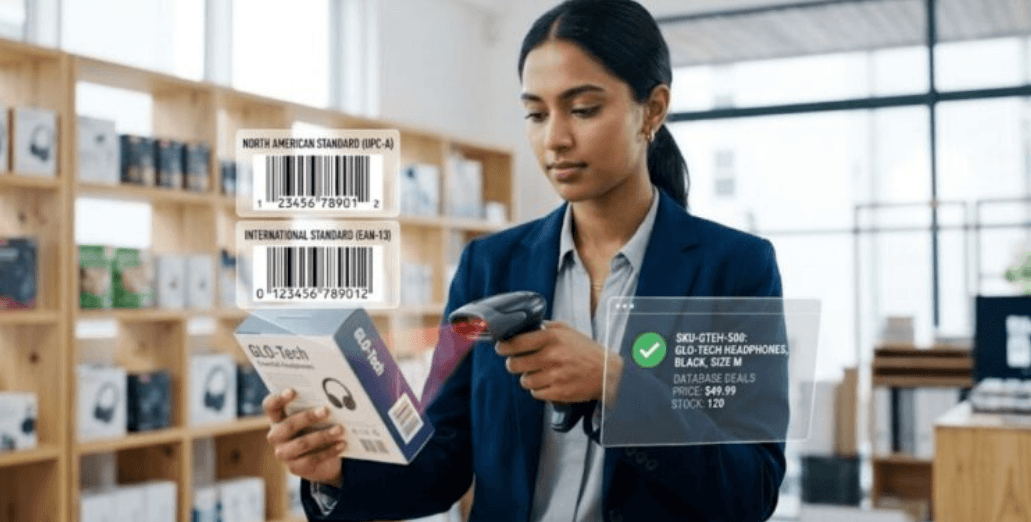
Anyone who has tried to wire barcode lookups into an app knows the problem isn’t scanning the code — phones do that fine. The problem is what happens after the scan, when a raw twelve-digit number needs to turn into a product name, a brand, a category, maybe an image. That gap between “here’s a UPC” and “here’s what it is” is where a lot of small e-commerce tools and inventory systems quietly fall apart.
A database built around the boring part
This is the space BarcodeReport occupies. It’s not trying to be a barcode scanner app, and it’s not selling point-of-sale hardware. It’s a lookup layer — a large, searchable set of UPC and EAN records that a developer, a reseller, or a small retailer can query when they need to know what a code actually corresponds to. Type in a barcode, get back the product details attached to it. That’s the whole pitch, and it’s a useful one precisely because it’s narrow.
EAN and UPC aren’t quite the same standard — EAN-13 is the international default, UPC-A is the 12-digit format still common in the US and Canada — and any tool that handles retail data has to deal with both without making the user think about the difference. A barcode reference site earns its keep by getting that translation right consistently, across categories that have nothing in common with each other: a barcode on a bag of rice behaves the same as one on a bottle of shampoo or a phone case, and the lookup has to work regardless.
Who actually reaches for a tool like this
Three groups tend to show up for barcode data, and they want different things from it.
● Developers building inventory or POS software, who need an API or bulk lookup so their app doesn’t ship with a blank product field every time a customer scans something unfamiliar.
● Small online sellers listing secondhand or wholesale stock, who just want to paste in a code and get a product title back instead of typing descriptions by hand for hundreds of SKUs.
● People doing one-off checks — is this the right item, is this barcode even registered, does this match what the listing says — where a quick web search on the code itself is the fastest path to an answer.
What actually matters in a barcode database
Coverage is the obvious metric, and it’s the one most sites lead with, but it’s not the only thing that decides whether a lookup tool is worth using. A database can be enormous and still be frustrating if half the entries are stale brand names or missing categories. The more useful question is how current the records are and how they’re organized — whether a search returns just a name, or something closer to a full product profile: brand, category, sometimes an image, sometimes package size.
On that front, barcodereport.com is built around a straightforward search experience: enter a UPC or EAN, get the matching record. For a developer evaluating whether to integrate a barcode data source, that simplicity is actually the selling point — it means less time spent reverse-engineering a response format and more time shipping the feature the barcode was supposed to support in the first place.
Where the format choice matters
It’s worth being specific about UPC versus EAN here, because the distinction trips up more integrations than it should. UPC-A codes are 12 digits and dominate US retail; EAN-13 codes run 13 digits and are the norm almost everywhere else, including most of Europe. A US-made product sold internationally often carries an EAN-13 that’s really just its UPC-A with a leading zero added — which is convenient in theory but a common source of bugs when a lookup system treats the two as unrelated formats instead of recognizing the overlap. A barcode reference tool that handles this cleanly saves whoever’s building on top of it a fair amount of debugging.
See also: PCredCom: Change the way you buy Tech and Electronics in Mexico
The limits worth knowing about
No public barcode database is complete, and it’s fair to set expectations accordingly. Store-brand items, regional products, and anything manufactured in small runs are the categories most likely to come back empty, simply because the data has to be reported or scraped from somewhere, and small producers don’t always register their codes the same way large manufacturers do. That’s true of every barcode lookup service, not a specific weakness of any one of them — it’s a structural feature of how this data gets collected in the first place.
What that means practically is that a barcode database is best treated as a strong first pass rather than a guaranteed answer. For high-volume retail goods — packaged food, electronics, well-known personal care brands — hit rates tend to be solid. For niche or local products, expect gaps, and plan for a manual fallback in whatever workflow depends on the lookup.
The bottom line
Barcode lookup is one of those pieces of infrastructure nobody thinks about until it’s missing. A tool that turns a scanned number into a usable product record, without requiring a developer to build and maintain that mapping themselves, saves real time — and for smaller teams especially, that’s often the difference between shipping a feature and shelving it. BarcodeReport fits that role: a focused reference for UPC and EAN data, useful less because it does anything flashy and more because it does the unglamorous lookup work reliably.